How to boost your EQ
She was a young girl with an attitude 10x that of a grown woman. She was avoiding her work, talking constantly, distracting others, doing all the things kids do when they have a substitute teacher. And after reminding her a dozen times to stop distracting others and focus on her work she told the substitute that she was going to, “beat them with her water bottle.”

WHEW! How does a person react to that!?
They tap into something called Emotional Intelligence (EI for short) and use skills they develop through EI training to navigate the situation.
This was a moment I found myself in not too long ago. It was my 4th or 5th day substitute teaching after several years away from the classroom. And this was a moment that previously would have completely drained my emotional and mental energies. But on that day, I had some new tools in my teacher’s toolbox that helped me navigate the situation. I tapped into the emotional intelligence section of my toolbox to regulate myself, get curious about this student and their behavior, and better connect with them. It was an opportunity for me to lead this young girl and model for her the benefits of developing one’s emotional intelligence.
Hey Skillz, what is emotional intelligence?
Great question! According to the National Institute of Health, “Emotional intelligence (EI) refers to the ability to perceive, express, understand, and manage emotions.” I want to further elaborate that EI is the ability to manage and express one’s OWN emotions, and perceive and understand the emotions of OTHERS.
It’s a field of psychology and human behavior that hasn’t been around for very long. It was only in the early 90s that researchers & psychologists like Peter Salovey, John D. Mayer, and Daniel Goleman, began to define this different type of intelligence.
What did these people learn about Emotional Intelligence?
They learned a lot about people and how emotions play a role in our lives. In 1995, Daniel Goleman authored, ‘Emotional Intelligence: Why It Can Matter More Than IQ’ so people can understand the theory of EI without needing a research or psychology background.
In it he outlined a core framework to categorize the key parts that make up emotional intelligence.
Goleman’s Four Domains are:
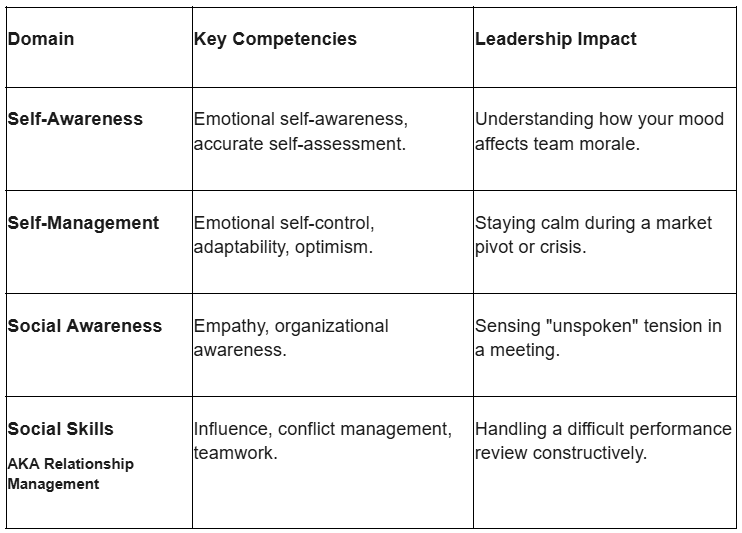
Each of these domains build on the next with the first and most important domain to master being Self Awareness. Anyone can increase their emotional intelligence by re-wiring their brain through intentional practice but it starts with one’s self.
I’ll share with you a story of someone I led that wanted so badly to connect with others (social skills/relationship management) but struggled because they lacked self-awareness.
Let’s refer to them as Arthur. Arthur was energetic, extroverted, and thrived when connecting with others. When I first met Arthur I found their energy and joy to be contagious. They confidently shared things they had worked on at past places and honestly, I was impressed. This was a person that I thought had a lot of great experience both technically and socially. However, over time I started to notice some things that weren’t lining up. As Arthur got more and more settled into my team, their work started to highlight technical skill gaps and I began hearing concerns from others about Arthur and some discrepancies in their background.
When someone strengthens the first 2 domains of EI, self-awareness and self-regulation, it becomes easier for that person to strengthen the social domains. One can more easily see in others areas of EI weakness, including a lack of self AND social awareness. This was starting to become the case with Arthur.
Others around them that had high EI were noticing a lack of self-awareness in them that was now beginning to affect Arthur’s ability to use social skills to connect. Because Arthur lacked self-awareness, they then also lacked social awareness.
In the end, I observed a person that so badly wanted to connect with others be sabotaged by the one thing they had full control over, their own self.
And this is not the only time I have observed this issue. For Arthur, the solution was to take a step back and start doing the work on themselves to strengthen and grow their EI through self-awareness and self-regulation. They had great potential to become an awesome team member, and as much coaching as a leader can do to help these individuals, sometimes the best help is from an outside party.
The moral of Arthur’s story is this, when someone is lacking self-awareness their efforts to connect socially have an opposite effect from their intentions because they are not able to use social skills to achieve their desired goal. They overcompensate for their lack of self and social awareness and push people away.
That’s a good example, but how does this story relate to EI and leadership?
Arthur’s experience included kind and caring leaders that worked with both Arthur and the team to repair some of the issues that had come from Arthur’s EI struggles.
Leaders often find themselves in situations like this where a personnel issue is developing, creating tensions within the team that, if ignored, begin to destroy trust and culture. So when leaders have high EI and are equipped with the right social skills to effectively manage people, they can more quickly and confidently address issues, bringing their team back together without major damage to repair.
And now, in 2026, it is even more vital to grow your EI as it’s considered more important to leadership and employee development than IQ. While technical skills are becoming more automated, demand for strong “people” or soft-skills is skyrocketing. As of 2025, according to ElectroIQ, Emotional Intelligence is viewed as a “strong predictor of performance” with 58% of success being attributed to high emotional intelligence skills, across a variety of different jobs, including teaching.
If strengthening emotional intelligence is so important as a leader, how does one go about it?
Another great question. Emotional intelligence, sometimes referred to as EQ is rather workable in the sense that our brains can be rewired to increase our EQ.
As mentioned in Arthur’s story, it starts with the self. You have 100% control over your emotions and reactions. I also want to highlight from the NIH definition of EI that it’s the ability to manage and express one’s OWN emotions. We can’t control how others respond to or feel about a situation. It all starts with YOU! John Maxwell, a top expert in management and leadership, begins his teachings with, “you cannot lead others until you first lead yourself.” There’s a reason he’s one of the best in leadership.
So, how can a leader begin to strengthen their Emotional Intelligence?
Explore Your Own Emotions. Schedule some time at the end of the day today to write a list of the different emotions you felt throughout the day. Use the following questions to guide this reflection:
What emotions did I experience today?
What did I observe in myself when I experienced these emotions?
How did my body react to these emotions? (elevated heart rate, rapid breathing, leg shaking, flushed cheeks, smiling, frowning, etc…)
Practice the art of breathing. I know, we all do this everyday, automatically, shouldn’t we be masters already? No. When learning to self-regulate, the fastest way to get regulate the fight or flight response is through deep, controlled breaths. Try this exercise once per day, it takes just a few minutes.
Breath in through the nose for a count of 4 (slow and controlled)
Hold for 2
Breath out through mouth for a count of 8 (slow and controlled)
Hold for 2
Repeat
Observe the world, but don’t be creepy. Go to a local coffee shop or park and simply observe the interactions around you. Pay attention to facial expressions and body language. So many of our emotions are communicated through non-verbal cues. Use the following questions as a guide for this exercise.
What am I noticing about the facial expressions of others during their interactions?
How many people are smiling? How many are frowning?
What am I noticing about people that are sitting alone?
What am I observing about myself during this exercise?
Share with others what you are learning. Let your team or maybe your colleagues know what you are learning about your own Emotional Intelligence. Tell them how it is impacting you and what the most important thing is that you have learned about yourself.
One of my favorite quotes about EI comes from Dr. Goleman himself, “people’s emotions are rarely put into words, far more often they are expressed through other cues… the key to intuiting another’s feelings is in the ability to read nonverbal channels, tone of voice, gesture, facial expression and the like.”
This is all great information Skillz. How might I get my company on board?
When companies invest in and encourage the development of EI in their leaders and employees, they are more likely to report higher revenue growth, employees are less likely to quit, and innovation that benefits customers increases.
It’s no longer a question of, “should the company invest in emotional intelligence training?” But “WHEN should we schedule the training?”
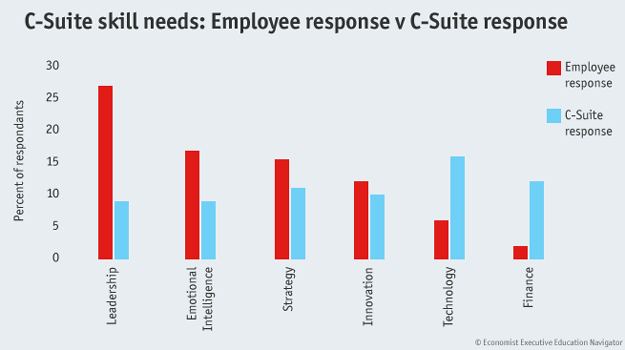
If you are a leader reading this right now, you can start growing your EI today. Start by assessing your own EI. Which domain do you feel you could grow most in?
Sources:
https://electroiq.com/stats/emotional-intelligence-statistics/
https://pmc.ncbi.nlm.nih.gov/articles/PMC8701889/
Additional Resources:
Coaching for Leaders Podcast: Episode 391
https://coachingforleaders.com/podcast/391/
How Leaders Lead Podcast: Episode 52
https://howleaderslead.com/leaders/88/Johnny-Taylor/