From Burnout to Balance
“Skillz! I’m so burnt out, overwhelmed and just plain exhausted! What should I do?!”
If I had a nickel for every time I heard this from a client… well I’d have more than just one nickel.
A top contributor to burn out is a lack of healthy boundaries in work and life. And the hardest part is that, most of us know our lack of boundaries is leading to our burn out.
But, we also don’t always know how to effectively set and maintain boundaries that meet our needs. So in this post, I am going to answer 3 common questions around boundaries and give you some tips on how YOU can start setting HEALTHY boundaries in your leadership and your life.
As part of my enRICH your leadership | enRICH your life program, boundaries fall under the fourth value, Humility. Because effective boundary setting and maintenance requires high emotional intelligence, clarity of priorities and strong communication, leaders need to build skills in the areas of Relationships, Innovation, and Communication first.
What does setting boundaries have to do with Humility?
Great question! Let’s start by defining what Humility actually is… “the quality or state of being humble” (Merriam-Webster). Ok… and being Humble means… “not proud… : not arrogant or assertive” (Merriam-Webster).
Yet, boundaries are often associated with some antonyms of humility, like assertive and arrogant. But what if I told you that the opposite is true. That boundaries set with humility come from leaders that care deeply and want to serve others. That they do so humbly knowing that they are but one person and can’t be everything to everyone all at once.
If the definition of humility is about being less arrogant, then the ego has to be tamed. Therefore, in order to set and maintain healthy, effective boundaries, a leader must tame their ego and tap into their emotional intelligence in order to know which boundaries to set and with whom to set them.
BOOM! Question answered. What’s the next one? (ooh not very humble, Megan, check the ego.)
Alright, now that we’ve covered that and I’ve checked my ego at the door, let’s answer some other common boundary questions.
What ACTUALLY are boundaries?
Boundaries in leadership are tools used to protect your time as a leader, to promote the development of your team, and to prioritize the work of the business.
Remember in my productivity post, “It’s Not About Time…”, I talked about the different types of energy we expend and need to replenish; physical, mental, emotional, and spiritual.
There are different types of boundaries that a person might set to protect each of the four different energies.
Boundaries also help leaders maintain focus on the company and team priorities so they can more effectively manage the work, their team, & their clients all leading to higher performance and engagement. However, they also help leaders manage the various demands between their work and personal lives, too. The idea that work stays at work and home stays at home no longer aligns with the world we live in today. Technology and remote work environments have further blurred the lines of “work-life balance”. Without healthy boundaries, leaders burn out at record pace because there is no definition of where the work persona ends and the personal one begins.
Setting boundaries helps to ensure sustainability and longevity for the leader, the team, and the company. As well as support leaders and team members in living healthy lives outside of the workplace.
Why does it feel like such a struggle to set and maintain healthy boundaries?
Boundaries often fail because most people struggle with two things. One is a fear that a boundary is going to push people away or cause uncomfortable conflict and the other is a lack of confidence and understanding of what boundaries actually are, keeping them from setting and maintaining them effectively.
It is common to view boundaries as negative things that cause drama or lead to isolation. If we think of boundaries as a fence around your yard and house (you are the house and your energy is the yard), you might imagine someone you know that has a fence that’s 14 feet high with no gates or windows. Leaving them to live an isolated, lonely life. BUT boundaries don’t have to lead to isolation. When used correctly, they actually bring more people to the yard, just like milkshakes do.
For those that grew up watching Home Improvement or Boy Meets World, you likely remember neighbors like Wilson (Home Improvement) and Mr. Feeny (Boy Meets World), and you likely just yelled out “FFFFEEEENEY” in your head as Eric Matthews did. Let’s take a moment and recall the types of fences they had… Wilson’s fence was taller and blocked most of his body and face, all we could see were his eyes and the different hats he’d wear. Mr. Feeny on the other hand, his fence was about hip/waist height and had gaps, making him completely visible, yet, there was a clear differentiation between his yard and the Matthews yard.
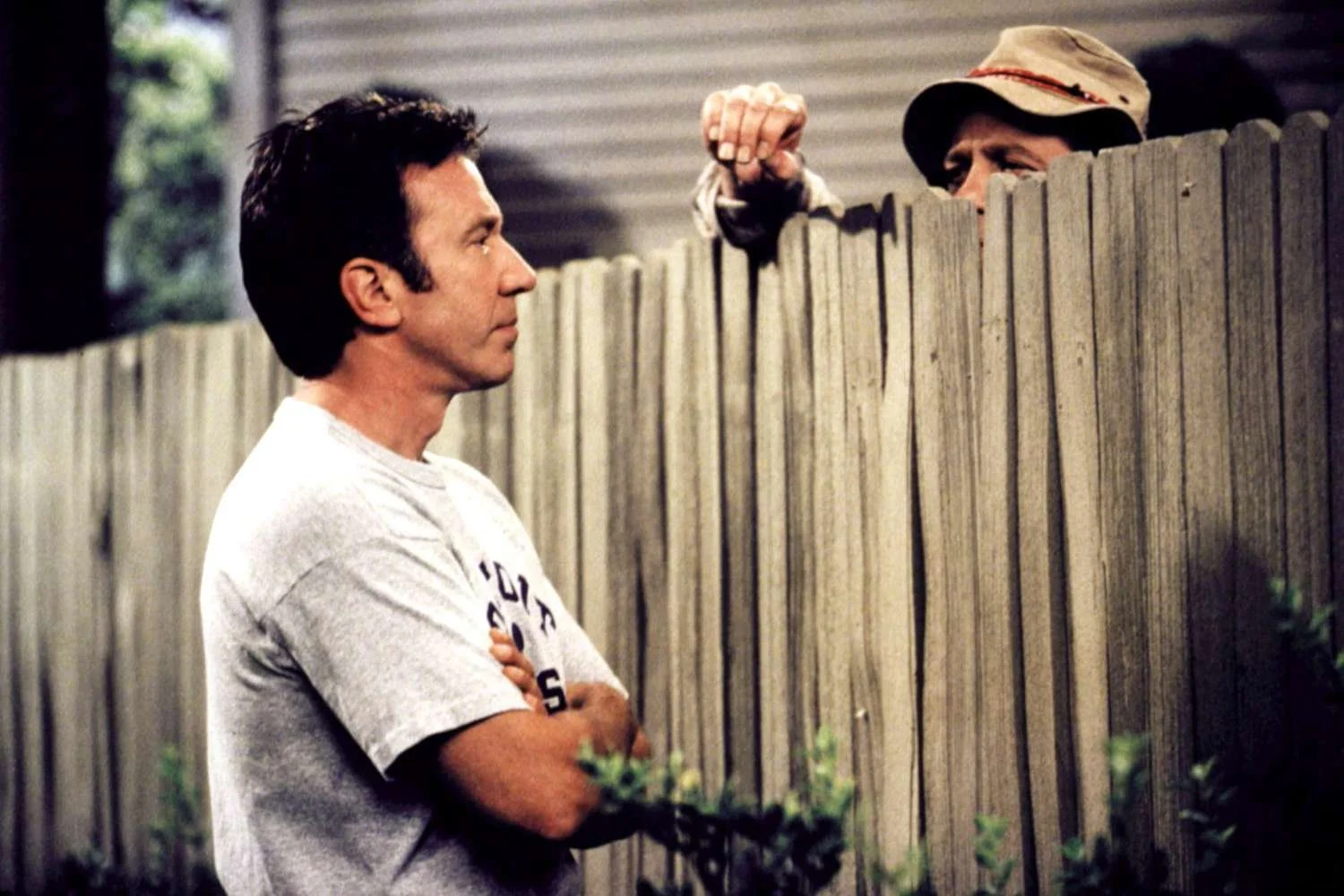
Neighbor Wilson sharing advice and offering guidance to Tim Taylor - Home Improvement (ABC)
Now, even though Wilson’s fence was taller and concealed most of him, was he isolated? Was he alone? Did he connect with his neighbors? Did he have heartfelt, genuine, vulnerable, conversations? No. No. Yes and yes. And even though Mr. Feeny’s fence was more open, did the Matthews’ respect his boundary? Yes. This illustrates how individuals can use boundaries to protect their energy, minds, spirits, etc… without shutting out the world.

Long-time neighbor and teacher, Mr. Feeny, advising and counseling a young Cory Matthews. Boy Meets World (ABC)
Getting better at setting and maintaining healthy boundaries starts with shifting the mindset you have toward how boundaries impact your life. Your boundaries are meant to support YOU. If you want to set boundaries and still be accessible to people, there are ways to do both. Setting balanced and healthy boundaries is the goal we should all be working toward.
Boundaries also often fail because they aren't clearly communicated. Often leaders come up with a boundary in their mind and fail to communicate it, or they set boundaries with an unrealistic expectation that others can read your mind and that if you say the boundary once it’s going to be remembered. Spoiler alert! It’s not. You have to repeat yourself at least 7-15 times for information to stick.
How do I go about setting AND maintaining healthy boundaries?
For starters, to set and maintain healthy boundaries, you have to start with emotional intelligence. You have to be self-aware as well as able to self-regulate as these are key to understanding when you need to set a boundary and knowing when a boundary is being crossed. People will inevitably challenge a boundary, especially when it’s new. Those that have benefited from you having unhealthy or nonexistent boundaries will struggle at first to accept and adjust to the new expectations. And when those new boundaries are being tested, instead of losing emotional control and getting upset with the person doing the testing, strong leaders regulate themselves before responding in order to continue building a positive association with the new, healthy boundaries.
To know what boundaries you need to set, you need to bring awareness to a few things.
Your values and priorities
Current energy expenditures
Non-negotiables and Adaptables
Boundaries are a key part of productivity management so a leader also needs to be very clear about the work and the goals that they and their team are trying to achieve so that they can set the right boundaries and maintain or even flex those boundaries as needed. You need to be very clear on what it is you're trying to achieve and how those boundaries will help you achieve that. Otherwise, you run the risk of setting boundaries that are too rigid, misaligned, or inconsistent and confusing.
To begin to bring balance back to your life, start by assessing your values and priorities. Conduct an energy audit of current tasks, projects, and work that are both draining and refilling your energy. Then establish your non-negotiables in both work and life. Those things that no matter how stressful the day or heavy the workload, you have to do it; aka the bare minimum of your work and life. Once you know what your non-negotiables are, you can more easily identify what your adaptables are, those things that can adjust or flex without causing major stress or chaos in your life.
You also have to learn to become comfortable with the discomfort of setting AND holding your boundaries. Not everyone is going to understand them or even like them, but boundaries are vital to not only your success and well-being, but to others as well. I know you have been uncomfortable in your work and life before, so I know you can handle a little more in the short-term to become a stronger leader in the long-term.
Resources:
Book:
Dr. Henry Cloud - ‘Boundaries for Leaders’
Article:
Forbes: Jenn Lofgren: ‘The Role That Boundaries Play in Leadership Growth’, May 2021
Podcast:
Confident at Work: Episode 193: ‘How to Set Boundaries Without Feeling Guilty at Work’